
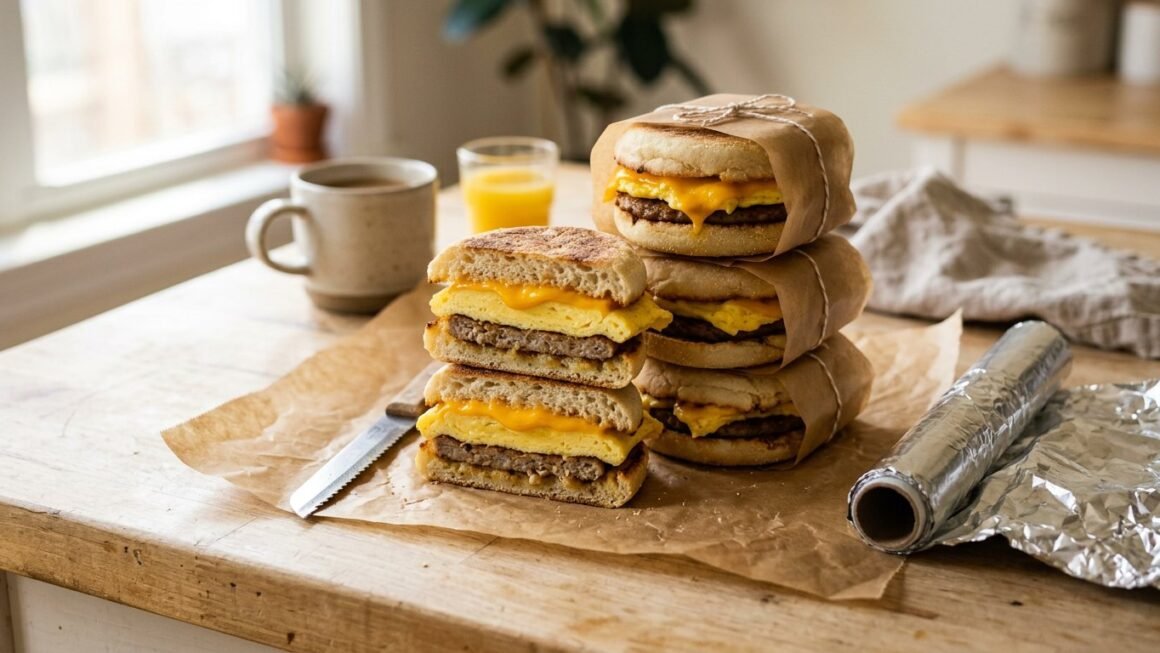
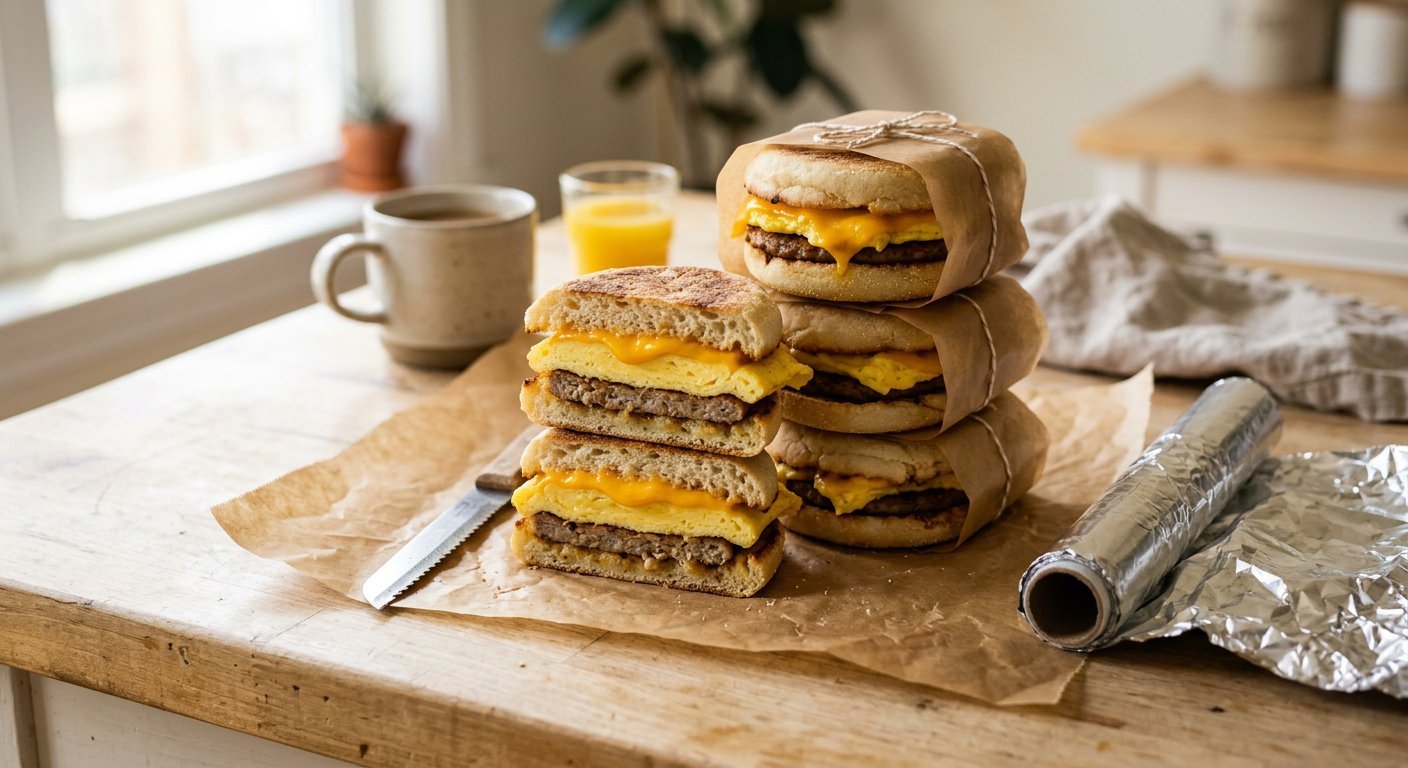
Try these freezer breakfast sandwiches if your mornings are a scramble. An hour on a Sunday gives you twelve sandwiches that reheat from frozen in 90 seconds and genuinely taste like something you made fresh. The trick that stops them going soggy is letting everything cool completely before wrapping. Here’s exactly how I make them.
Why You’ll Love This Recipe ❤️
- Twelve sandwiches in one hour: Sheet pan eggs mean no standing at a frying pan.
- 90 seconds from frozen: Faster than a drive-through and far cheaper.
- 26g of protein each: Genuinely filling rather than a sugar spike.
- Around a third the cost: Compared with buying breakfast on the way to work.
Minimal Effort, Maximum Impact ⚡
Baking the eggs in a sheet pan and cutting them into squares removes the tedious part entirely. Twelve eggs cook at once in about 15 minutes.
Budget-Friendly Comfort 💰
English muffins, eggs, cheese and sausage work out to a fraction of what the same sandwich costs from a coffee shop.
What You’ll Need 📝
Toast the muffins before assembling, even though they will be frozen and reheated. A toasted surface resists moisture from the egg and cheese, and it is the second half of what keeps these from turning soggy.
- 12 English muffins, split
- 12 large eggs
- 1/2 cup whole milk
- 12 slices sharp cheddar or American cheese
- 12 breakfast sausage patties, or 24 slices Canadian bacon
- 2 tablespoons butter, softened, for the muffins
- 1 teaspoon kosher salt
- 1/2 teaspoon black pepper
- 1/2 teaspoon garlic powder
Equipment 🛠️
- One 9×13 inch baking sheet with a rim
- Parchment paper
- Foil or sandwich wrap, 12 sheets
- Freezer bags
Step-by-Step Instructions 👩🍳
Read step six before you start. Cooling is the step everyone skips and it is the one that determines whether these are good or disappointing.
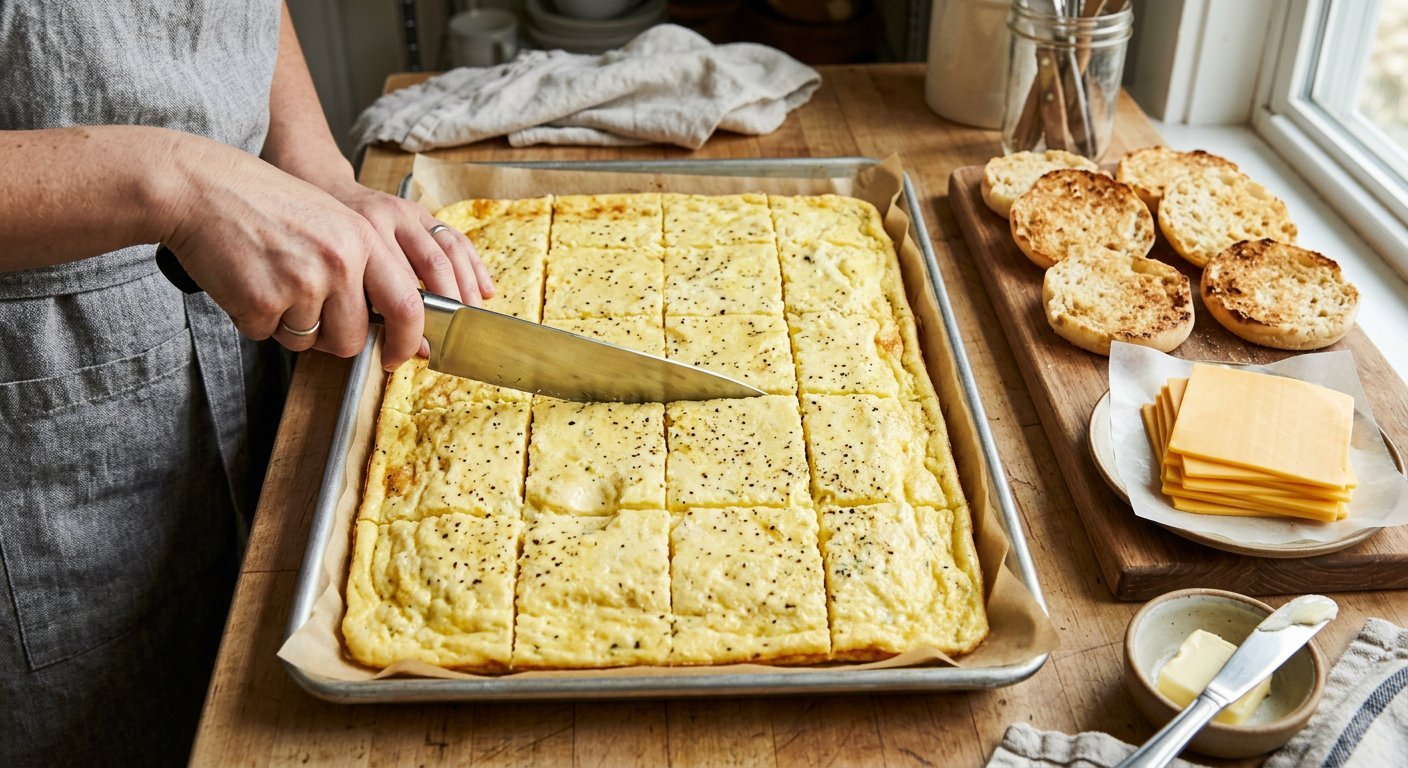
- Bake the eggs in a sheet pan. Heat the oven to 350°F (175°C) and line a rimmed 9×13 sheet with parchment, letting it come up the sides. Whisk the eggs, milk, salt, pepper and garlic powder until fully combined, pour in, and bake 15-18 minutes until just set with no wet centre. Baked eggs reach the USDA-safe 160°F easily at this temperature.
- Cook the sausage. While the eggs bake, cook the sausage patties through to 160°F, then drain on paper towel. Blotting the grease properly matters — excess fat soaks into the muffin during freezing.
- Toast the muffins. Split and toast all 12 until lightly golden, then butter the cut sides thinly. The butter forms a barrier against moisture, the same principle as buttering bread before a sandwich.
- Cut the egg sheet. Lift the parchment out and cut the egg into 12 squares roughly the size of a muffin. They will be slightly puffed and will settle as they cool.
- Assemble. Build each sandwich: bottom muffin, egg square, cheese slice, sausage patty, top muffin. Putting the cheese between the two hot components helps it melt slightly on reheating.
- Cool completely before wrapping. Leave the assembled sandwiches on a rack for at least 30 minutes until fully at room temperature. Wrapping anything warm traps steam, and that steam turns into ice crystals in the freezer and then into a soggy muffin when reheated. This is the single most important step.
- Wrap and freeze. Wrap each sandwich tightly in foil or sandwich wrap, then put them all in a labelled freezer bag with the date. The double layer prevents freezer burn.
- Reheat from frozen. Unwrap completely, wrap loosely in a paper towel, and microwave 90 seconds to 2 minutes, flipping halfway. For a crisper result, microwave 60 seconds then finish 5 minutes in a 350°F oven or air fryer.
Pro Tips for Success 💡
Never wrap a warm sandwich. Trapped steam is the entire reason homemade freezer sandwiches get a reputation for being soggy, and thirty minutes of patience solves it completely.
Do not skip toasting and buttering. Together they create a moisture barrier between the muffin and the egg, and the difference after two weeks in the freezer is dramatic.
Remove all foil before microwaving. This sounds obvious, but people reheat these half-asleep and foil in a microwave is genuinely dangerous. If you want the foil, use the oven instead.
Blot the sausage thoroughly. Rendered fat that stays on the patty migrates into the bread during freezing and makes the bottom greasy and dense (a minute with paper towel is enough).
Label the bag with the date. Three months is the quality limit and they all look identical after a few weeks in the freezer.
Common Issues & Fixes ⚠️
The muffin is soggy after reheating: Wrapped while warm, or not toasted first. Both trap or admit moisture. Cool fully and always toast.
The egg is rubbery: Overbaked, or microwaved too long. Pull the egg sheet as soon as it sets, and reheat in shorter bursts, checking as you go.
The middle is still cold: Microwave power varies a lot. Flip halfway and add 20-second increments rather than one long blast, which overcooks the outside.
They taste freezer-burnt: The wrap was loose or they were kept past three months. Wrap each one tightly and then bag them all.
Storage & Shelf Life ❄️
Frozen, these keep for up to 3 months at good quality, per USDA guidance for cooked egg and meat dishes. Beyond that they remain safe indefinitely at 0°F but the texture deteriorates noticeably. Keep them in the body of the freezer rather than the door, where temperature fluctuates most.
In the fridge, assembled sandwiches keep 3-4 days wrapped. Do not leave them at room temperature for more than 2 hours after reheating. If you want to prep partially, the egg sheet can be baked and refrigerated for 3 days before assembly, which spreads the work over two days.
Recipe Variations 🔄
Swap the bread — bagels, croissants, biscuits or English muffins all work. Croissants freeze less well because the layers compress, so eat those within a month.
Change the protein to bacon, Canadian bacon, turkey sausage or leave it out entirely for a vegetarian version. Add sautéed spinach and mushrooms if you go meat-free, but cook out all their water first.
Mix things into the egg before baking — diced bell pepper, scallions, cooked crumbled bacon or a handful of cheese all work. Keep any additions dry to avoid a wet egg sheet.
For a lower-carb version, skip the muffin and use the egg squares as the outside, with cheese and sausage between them. If you like this style of batch cooking, cowboy casserole also assembles ahead and freezes unbaked.
What to Serve With This 🍽️
These are designed to be eaten on their own, usually in one hand. If you are serving them at a table, fresh fruit or a simple yogurt and berry bowl balances the richness well, and a slice of classic banana bread rounds out a brunch table.
Hot sauce on the side is worth having. To drink, coffee is the obvious partner, or orange juice if you want the acidity to cut through the cheese and sausage.
Common Questions ❓
How long do they keep in the freezer?
Up to 3 months at good quality. They stay safe longer at 0°F but the bread starts to dry out and the egg texture suffers. Label the bag with the date.
Can I reheat them in an air fryer?
Yes, and it gives the best texture. Unwrap and cook at 350°F for 8-10 minutes from frozen. Microwaving 60 seconds first then air frying for 4 minutes is the fastest good option.
Why bake the eggs instead of frying them?
Twelve eggs cook at once in a single flat sheet, they cut into neat squares that fit the muffin exactly, and the texture holds up far better to freezing than a fried egg does.
Do I have to use parchment?
It makes lifting the egg sheet out in one piece far easier. Without it, grease the pan very well and expect to cut and lift the squares individually.
How many does this make?
Twelve sandwiches, which is roughly two working weeks of breakfasts for one person. The recipe halves or doubles cleanly.
Nutrition Facts 📊
Per sandwich, based on 12 sandwiches with sausage. These figures are (estimated — verify before publishing) and were not calculated against a live USDA database.
- Calories: 425 (estimated)
- Protein: 26g
- Carbohydrates: 28g
- Dietary Fiber: 2g
- Total Sugars: 3g
- Total Fat: 23g
- Saturated Fat: 10g
- Sodium: 890mg
- Cholesterol: 215mg
Macro Breakdown: Protein 24% / Carbs 26% / Fat 50% of calories.
Diet Tags: Nut-free, high protein.
Allergens: Contains eggs, milk (cheese, milk, butter) and wheat (English muffins).
Nutrition Notes: At 26g per sandwich this is genuinely high in protein, well over 20% of the daily value. Sodium comes mainly from the sausage and processed cheese — using Canadian bacon and real cheddar instead cuts roughly 250mg per sandwich. Turkey sausage reduces fat by about 7g each.
Final Thoughts ❤️
The reason most homemade freezer sandwiches disappoint is not the recipe, it is the assembly. Toast the muffin, blot the sausage, and let everything cool completely before it goes anywhere near foil. Do those three things and what comes out of the microwave on a Tuesday morning is genuinely good, not just convenient.
Nutrition is an estimate and varies by brand and portion.